Gaia Sky 3.7.2
By tsagrista on
Today is release day! We are proud to present Gaia Sky 3.7.2. This release contains many new features and bug fixes. We wrote a post covering most of them last week, so you may want to have a look at that. Nevertheless, below is a non exhaustive summary and further down a full list of all new features, bug fixes, and more.
- New shading types for billboards.
- Refactor of orbital element groups into particle groups.
- Dataset updates (FPR asteroids, Saturn rings).
- Anaglyph custom colors mode.
- Logarithmic and reset UI sliders.
- New languages: Simplified Chinese, Japanese, Italian.
- OptFlowCam improvements.
If you want to know more, keep reading.
Billboard shading types
We have added three shading types to particle groups:
plain—same old emissive shading.billboard_shading—particles are shaded uniformly depending on the view and light directions. This creates the illusion of physical particles, especially when these are small.spherical_shading—particles are shaded using the Phong model as if they were spheres. Normals are computed for every fragment in the billboard, and light contributions are calculated according to those, taking into account the light and view vectors. This process shades the particles as if they were solid bodies.

The lighting types. Left: plain, center: billboard shading, and right: spherical shading.
Orbital element groups refactor
We have merged orbital element groups into regular particle groups, consolidating the data model and gaining all the particle group goodies: filtering, indexing, focusing, texturing, and shading types.
- Updated FPR asteroids catalog—new version of FPR SSOs to use spherical lighting and textured particles.
A trip through the asteroid belt with Gaia FPR data.
See the higher quality version on YouTube.
- Add support for particle-based rings in ringed planets. This includes a number of refactorings and improvements.
- Saturn rings—new dataset containing 1.5 million particles of dust and rock in the rings of Saturn. They rotate realistically, as they were generated with physically plausible orbital elements.
Exploring the new Saturn rings dataset.
See the higher quality version on YouTube.
- Diffuse scattering—added the diffuse scattering property to particle groups, used in conjunction to global ambient light setting.
- Enable asteroids and other particle groups to use a different epoch per particle.
Light glow effect rework
We have put some work into the star glow effect by adjusting its parameters and adding a time variability in the form of a polar mask.
- Add time-dependent polar mask to star glow effect. Update default star/glow texture indices and glow factor.
- Separate star from glow texture in settings. Add image next to select boxes to provide visual feedback about the selected textures.
Exploring the new Saturn rings dataset.
The time variability in the light glow effect.
Transparent handling of name conflicts
We have added a name conflicts window to inform the user of index conflicts in the current session. This prompted some dataset updates to make sure that there are no name conflicts in the essential catalogs:
- Base dataset: remove Lutetia and Steins. Fix typo in Hygieia.
- Asteroids/SSO FPR: remove all objects that are already in the base dataset, which is always loaded (minor planets—Vesta, Ceres, Hygiea, Iris, …—, and moons of Saturn, Jupiter, Uranus, and Neptune).
- Nebulae: fix internal naming issues and misnamed objects.
- NEARGALCAT: fix conflicts with constellation names by adding the " galaxy" suffix to some objects. Use procedural generation for Andromeda.
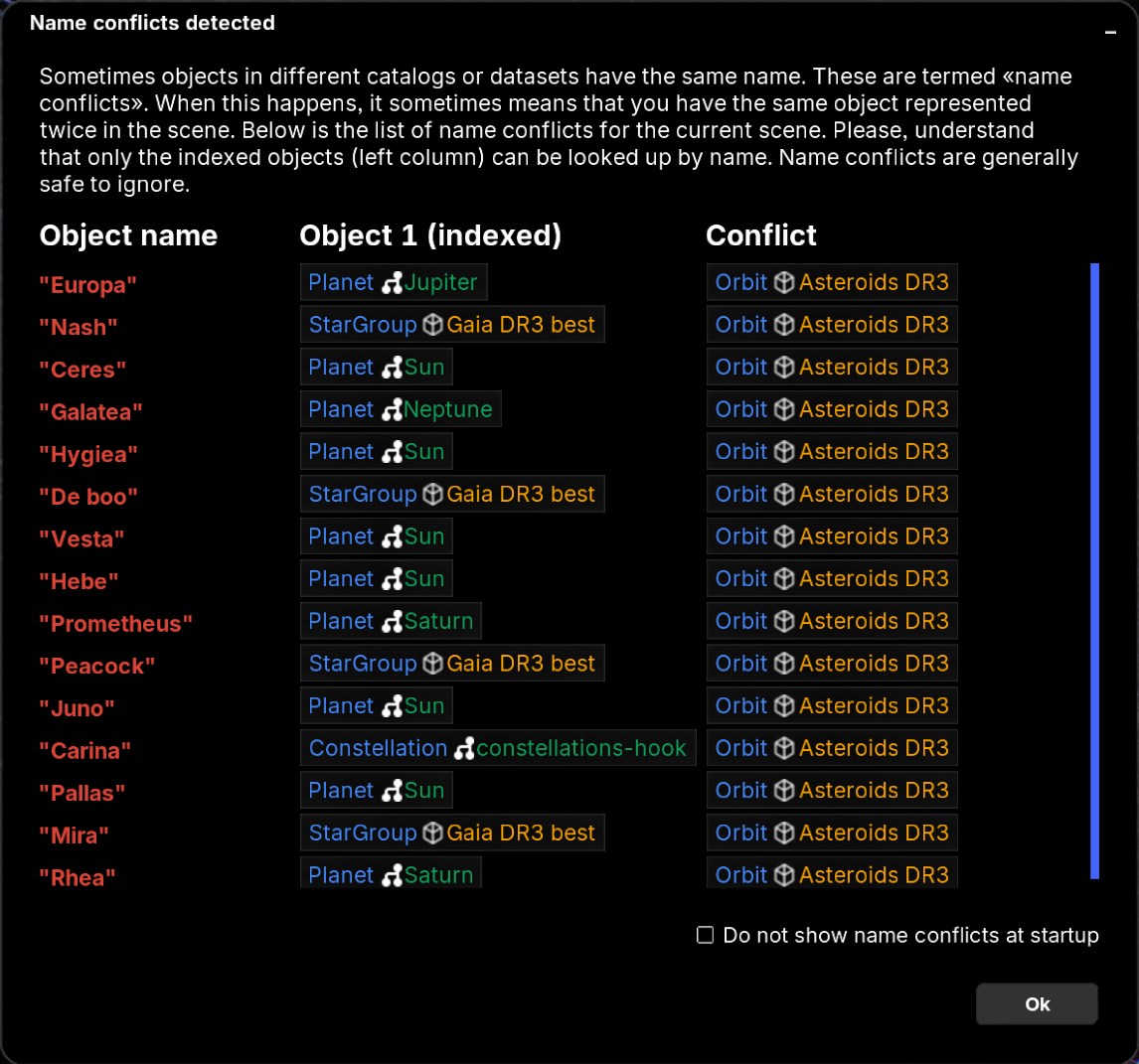
The new name conflicts dialog pops up at startup if conflicts are detected.
Internationalization and translations
We have received contributions to add Simplified Chinese, Italian, and Japanese (WIP) to the list of supported languages. We have also updated and completed the translation files for Slovenian, Turkish, and Russian.
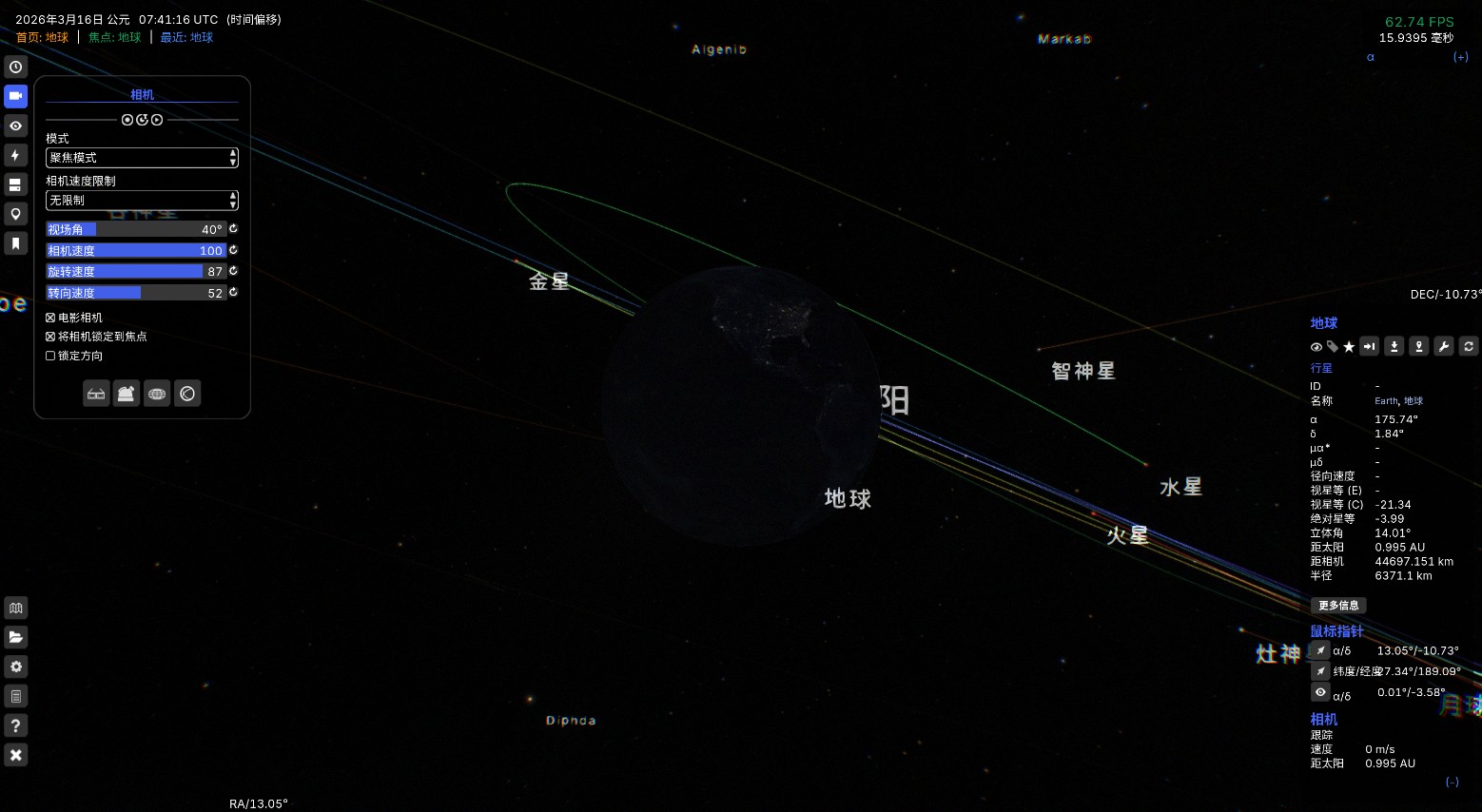
The user interface and objects can now be completely translated to Simplified Chinese.
User interface updates
We have many user interface new features and updates:
- Move from static font files to
gdx-freetypelibrary. This enables us to support CJK languages and more. - Remove monospace fonts from Gaia Sky UI and skin. They are used very sporadically and are not really needed.
- Maintain aspect ratio of background image in welcome and loading GUIs by letter-boxing.
- Add Copy to clipboard button to log window. Add text and icons to all buttons in the window.
- Read contributors from
CONTRIBUTORS.mdfile instead of hardcoding the data in About Window. - Add Mastodon and BlueSky icons and links in about window. Add tooltips with funding agencies’ names.
- Update splash image. Add dark background to central table in loading GUI.
- Add Overwrite check box to file export dialogs.
- Use degrees for min/max particle size in dataset visual settings dialog.
- Improve reset sliders (sliders that have a button to reset their value).
- Directly connect events to sliders to handle updating/firing automatically.
- Move planetarium and cubemap settings to sliders from free-text input fields.
- Remember last camera file name in keyframes window to avoid having to enter it every time.
- Use reset sliders in settings window, and camera/visual settings panes.
Stereoscopic and anaglyph 3D
We have added a new anaglyph profile which lets the user select custom colors for the left and right images.
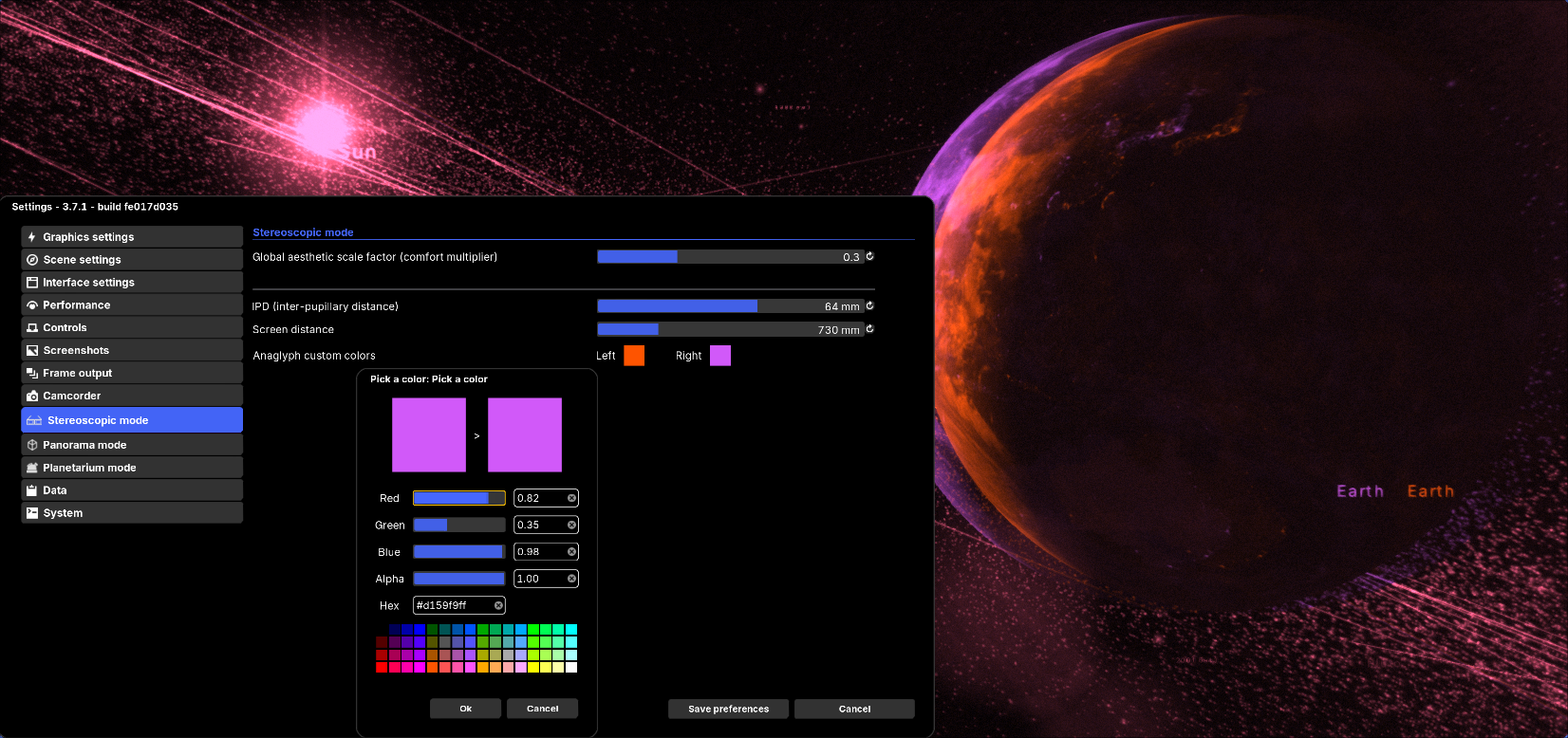
In the new custom anaglyph mode, the user can pick and choose the colors for the left and right eyes.
Camcorder and OptFlowCam export
We have fixed some bugs with the CatMullRom splines in the OptFlowCam export script that fix camera orientation discontinuities. This export method should now be much more reliable. Additionally, we have replaced the old manual dependency management with uv, which is faster and more secure.
Dataset management
We have implemented a mechanism to mark datasets as obsolete or outdated whenever a newer, better dataset comes around. In the same fashion, we added replaces and replacedBy properties to dataset descriptors, so that the user is informed. Finally, we cross-check these new fields for both local and server datasets to ensure consistency.
Bug Fixes
Please, refer to the bug fixes section of the release changelog for the full list of bug fixes included in this version.
More
See the full changelog for 3.7.2 for the full list of features, fixes, and more.
You can grab the latest installer from the downloads page.