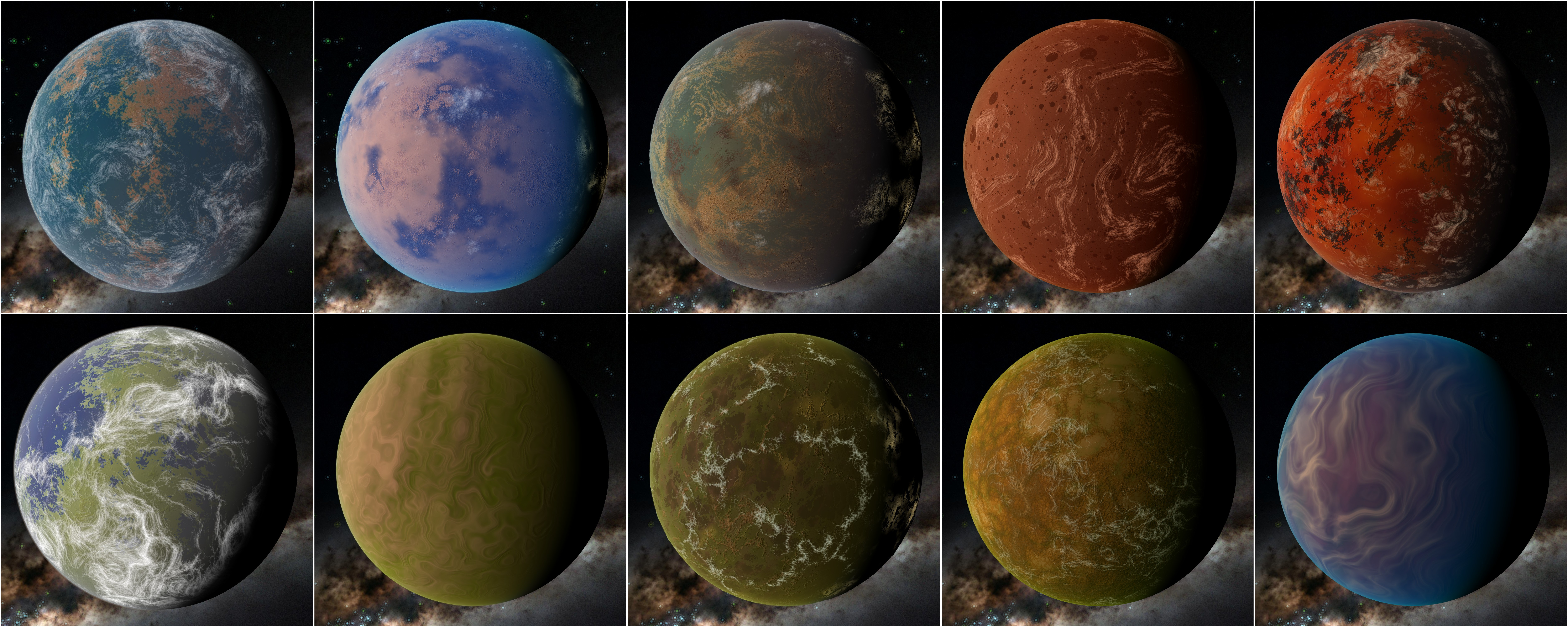
We are proud to announce the release of Gaia Sky 3.8.0. This release brings a mainor overhaul of the procedural planet generation system, with domain warping, 3D biome LUTs, new presets, and a consolidated single-pass generation pipeline. It also introduces higher resolution icons for HiDPI, custom view mode panes, and many bug fixes.
Important
Gaia Sky 3.8.0 requires an update in the default data package. You will be notified on startup that an update is available. Please, update!
Procedural planet generation in 3.8.0 featuring lava, tropical, and desert presets.
We are proud to announce the release of Gaia Sky 3.7.4. This release brings a major overhaul of the atmospheric scattering model with ozone absorption, Bruneton’s density scale, a unified ground/sky integrator, and a physically-grounded parametrization. It also includes important bugfixes for the keyframe system, and build system updates.
The revised atmospheric scattering model in 3.7.4 at work.
About a couple of months after the last release, today we are proud to announce Gaia Sky 3.7.3. This release focuses on quality-of-life features and on important bug fixes.
Here is a summary of what’s new in this release:
Complete redesign of “Load dataset” dialog.
Improve file picker with proper history stack and more goodies.
New line shading method based on screen-space derivatives.
PBR extensions to wavefront format.
Improve index creation speed for particle and star sets.
Fix breaking bug in 3.7.2 where model-based sets (e.g. star clusters) were not positioned correctly.
Today is release day! We are proud to present Gaia Sky 3.7.2. This release contains many new features and bug fixes. We wrote a post covering most of them last week, so you may want to have a look at that. Nevertheless, below is a non exhaustive summary and further down a full list of all new features, bug fixes, and more.
New shading types for billboards.
Refactor of orbital element groups into particle groups.
Dataset updates (FPR asteroids, Saturn rings).
Anaglyph custom colors mode.
Logarithmic and reset UI sliders.
New languages: Simplified Chinese, Japanese, Italian.
I have been skimming the Gaia Sky git log, and I think we have enough new stuff to warrant a new release. This means that we now enter a testing period that will, hopefully soon, end up with the new version 3.7.2.
If you follow my BlueSky or Mastodon feeds, you have probably already seen most of these features in action. However, for those of you who don’t, this post aggregates and summarizes all the information on the upcoming version.
We are excited to announce the release of Gaia Sky 3.7.1. This release was planned for last Christmas, but we had to postpone it due to the server outage issue. Now it is here! While there are many under-the-hood fixes, the highlights of this version are:
The new procedural galaxy generation system,
the PBR shader overhaul,
some notable UI improvements,
a revision of the atmospheric scattering algorithm,
Today we publish Gaia Sky 3.7.0. The main point of this release is to fix a show-stopping bug that occurs with the latest version of macOS, code-named Tahoe. On macOS Tahoe, Gaia Sky 3.6.11 crashes at startup due to the operating system hardware information library (oshi) returning nothing when asked for the operating system code name. This has been fixed in 3.7.0. But the fun does not end here, as 3.7.0 is cut from the bleeding edge development branch, so it includes all sorts of new features, QoL improvements, and additional fixes. Read on for more.
Exactly a week after the release of 3.6.10, we release Gaia Sky 3.6.11. This is a small-ish release that contains a few new API calls and some important bug fixes. Keep reading for the list of changes.